




A place marked by the great moments in French history
histoire
histoire
histoire
histoire
The territory of Cavoville and Mesnil-Jourdain, now closely linked to Clos du Veneur, is steeped in the deep history of Normandy and the Kingdom of France.
Over the centuries, this territory has witnessed—and sometimes participated in—major historical events that have left a lasting mark on the national memory.
Royal Hunts of the Middle Ages
From the Middle Ages onward, the Norman forests around Mesnil-Jourdain were renowned for their vast wooded areas, rich in game.
They constituted a prime location for the grand hunts of the lords and kings.These hunts were not mere pastimes: they represented a true rite of power, bringing together nobility, royal officers, and experienced huntsmen.
To learn more about hunting in the Middle Ages:
https://fr.wikipedia.org/wiki/Chasse_au_Moyen_%C3%82ge
The Le Veneur family, a lineage in the service of the kings of France
The Le Veneur family, whose name is directly linked to the function of huntsman (master of the hunt) royal), occupies an important place in Norman history.
Jean IV Le Veneur was notably appointed Grand Huntsman of the King during the reign of Philip IV the Fair, illustrating the prestige of this lineage.
Reference on the family and its historical role:
https://fr.wikipedia.org/wiki/Maison_Le_Veneur
⚔️ The Battle of Courtrai (1302)
In 1302, the Battle of Courtrai, also known as the “Battle of the Golden Spurs,” marked a major turning point in the conflicts between the Kingdom of France and Flanders.
Some members of the French nobility, including Jean IV Le Veneur According to family chronicles, they met their death there.
More information on the Battle of Courtrai:
https://fr.wikipedia.org/wiki/Bataille_de_Courtrai
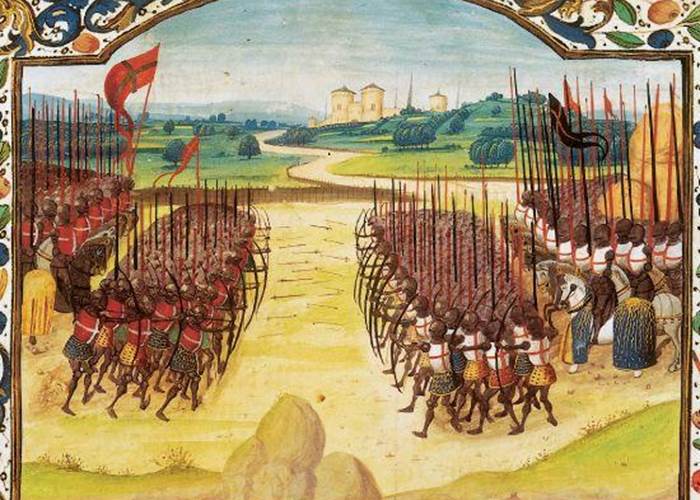
⚔️ The Hundred Years' War and the Battle of Agincourt (1415)
In the 15th century, the Hundred Years' War plunged France into a long period of conflict.
In 1415, the famous Battle of Agincourt saw the defeat of the French chivalry by the English armies. Jean VIII Le Veneur also perished there, illustrating the direct involvement of this lineage in the major conflicts of the kingdom.
More information on Agincourt:
https://fr.wikipedia.org/wiki/Bataille_d%27Azincourt
The French Revolution and the end of feudal structures
The French Revolution profoundly disrupted the old order. Seigniorial rights were abolished, lands redistributed, and the old feudal structures gradually disappeared.
Cavoville, like many villages, went through this period of radical transformation, marking the end of a centuries-old system.
Historical context of the French Revolution:
https://fr.wikipedia.org/wiki/R%C3%A9volution_fran%C3%A7aise
A memory still present in the landscapes
Even today, walking the paths around Mesnil-Jourdain, it is possible to feel this historical depth.
The forests, valleys, and farmland still bear the imprint of these past centuries.
Each element of the landscape evokes a continuity between history, nature, and living heritage.